
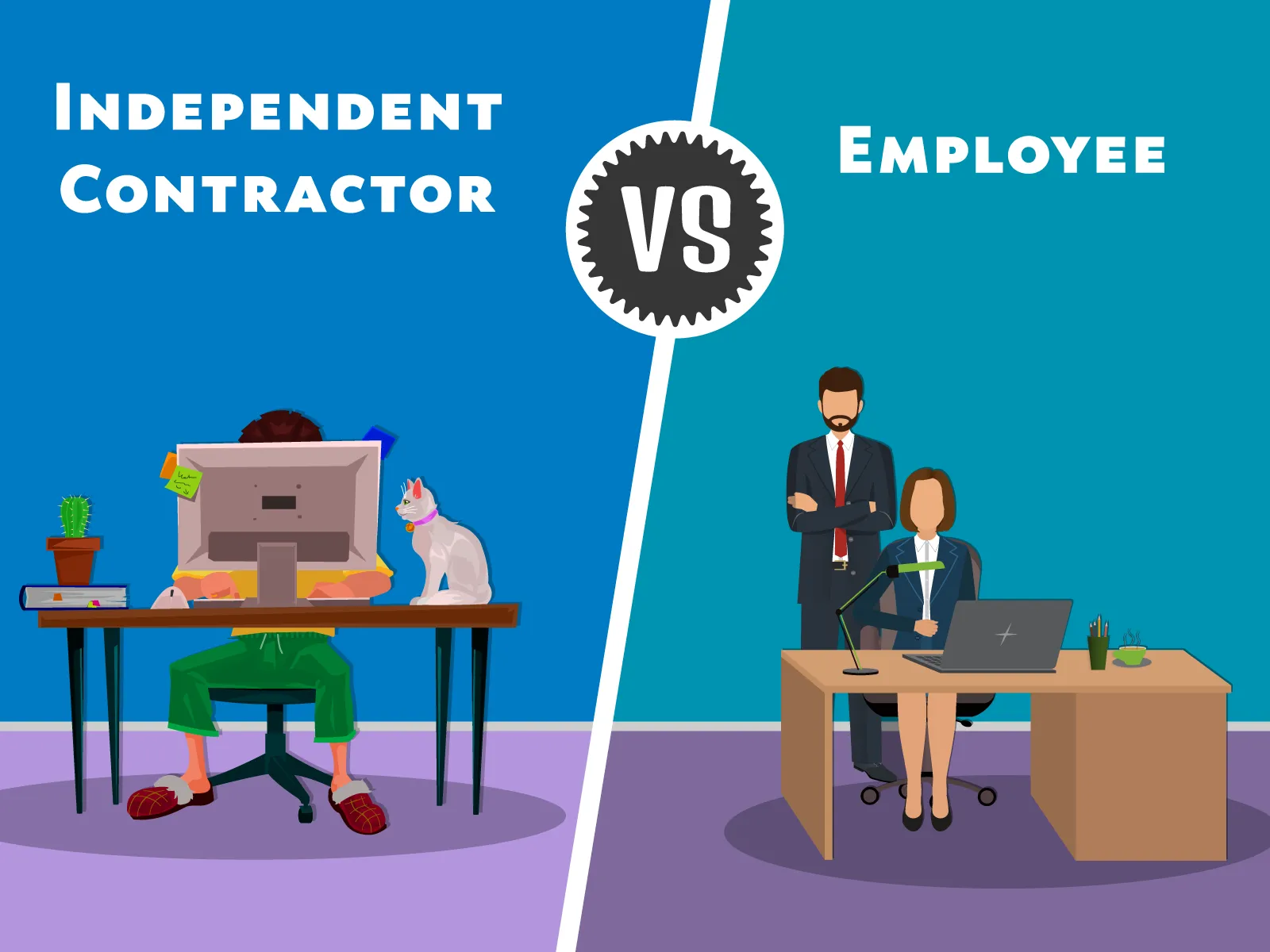
Understanding the difference between employees and contractors is one of the most critical payroll responsibilities for Canadian businesses. Applying effective payroll management tips can help reduce errors and ensure compliance from the start. Misclassifying a worker does not just create accounting confusion — it can trigger serious tax, payroll, and legal consequences with the Canada Revenue Agency (CRA).
Many business owners assume that issuing invoices or signing a contractor agreement is enough to avoid payroll deductions. In reality, CRA focuses on the true working relationship, not job titles or paperwork. This article breaks down payroll deductions, common mistakes, and legal risks so you can clearly understand employee vs contractor CRA rules and your real payroll obligations.
We deliver a broad range of Tax Accounting Services in BC and other locations across British Columbia.
On this page
- Employee vs Contractor Payroll Obligations
- CRA’s 4-Factor Test (Control, Tools, Financial Risk, Integration)
- What Is a Personal Services Business (PSB) and Why It’s Risky
- Penalties for Misclassifying a Worker in Canada
- How to Request a CRA Ruling on Worker Status (Form CPT1 / RC4110)
- Common Payroll Deduction Mistakes: Employee vs Contractor
- Legal and Tax Implications of Employee vs Contractor Classification
- How to Fix a Misclassification (Voluntary Disclosure)
- FAQ
Employee vs Contractor Payroll Obligations
| Payroll & Tax Factor | Employee | Contractor |
|---|---|---|
| Payroll deductions at source | Yes – income tax, CPP, and EI must be deducted | No payroll deductions at payment |
| CPP responsibility | Shared between employer and employee | Contractor pays full CPP personally |
| EI contributions | Mandatory for most employees | Not required (optional special benefits only) |
| Employer payroll cost | Higher due to CPP & EI employer portion | Lower upfront payroll cost |
| Tax reporting form | T4 issued by employer | T4A (in most cases) |
| Control over work | Employer controls schedule and methods | Contractor controls how work is done |
| CRA audit risk | Lower if payroll is handled correctly | High if misclassified as contractor |
| Legal employment protections | Yes (vacation pay, termination rules) | No employment standards protection |
In short, for an employee the employer must calculate, withhold, and remit income tax, CPP and EI every pay cycle and pay the employer portions, while a contractor is paid gross and handles their own income tax and CPP at filing — reported on a T4A rather than a T4. If you’re weighing incorporation, our T2 vs T1 guide clarifies corporate versus personal tax reporting.
CRA’s 4-Factor Test (Control, Tools, Financial Risk, Integration)
The CRA doesn’t look at what a contract calls the relationship — it looks at how the work actually happens. Its long-standing test weighs four factors to decide whether someone is an employee or genuinely self-employed.
- Control. The most important factor. Who decides when, where and how the work is done? If you set the hours, supervise the output and direct the method, that points to employment. A contractor controls their own schedule and approach.
- Tools and equipment. Employees usually use tools the business provides. Contractors typically own their own equipment, cover its maintenance, and carry the investment that comes with it.
- Chance of profit / risk of loss. Employees get a steady paycheque and bear no business risk. A true contractor can earn more by working efficiently — and can lose money if costs exceed revenue. Financial risk is a strong sign of self-employment.
- Integration. Is the worker part of the business or running their own? Contractors generally have multiple clients, market their own services and keep a distinct business identity, rather than appearing on the org chart.
No single factor decides it; the CRA weighs the whole relationship. If most factors point to employment, treating the person as a contractor is risky — regardless of what the agreement says.
What Is a Personal Services Business (PSB) and Why It’s Risky
A personal services business (PSB) is the CRA’s answer to “incorporated employees.” If you provide services through your corporation to a single client, and you would reasonably be that client’s employee if the corporation didn’t exist, the CRA can label your company a PSB — and the tax treatment is harsh.
Why a PSB is so costly:
- It cannot claim the small business deduction, so its income is taxed at the full corporate rate.
- An extra 5% federal tax applies on top, pushing the effective federal rate well above a normal corporation’s.
- It is denied almost all business deductions — only salary paid to the incorporated employee and a few costs are allowed.
In short, a PSB gets the worst of both worlds: corporate-level filing with almost none of the corporate tax advantages. Contractors who work full-time for one client through a corporation are the most exposed.
If you operate through a corporation, our corporate tax service can review your PSB risk before the CRA does.
Penalties for Misclassifying a Worker in Canada
Calling an employee a contractor doesn’t just risk a label change — it can trigger back taxes and penalties, and the payer usually carries the bill.
If the CRA reclassifies a worker as an employee, the payer can be assessed for:
- Unremitted income tax that should have been withheld.
- Both the employer and employee shares of CPP and EI — often going back several years.
- A penalty for failure to deduct: 10% of the amount, rising to 20% for repeat or grossly negligent cases.
- Interest on all of the above, compounded.
Beyond the CRA, provincial employment-standards rules may entitle a reclassified worker to vacation pay, overtime and termination notice — adding employment-law exposure on top of the tax bill.
Getting payroll right from the start avoids all of this. See our payroll services.
How to Request a CRA Ruling on Worker Status (Form CPT1 / RC4110)
If you’re genuinely unsure, you don’t have to guess. Either the worker or the payer can ask the CRA for a formal ruling on whether a job is pensionable (CPP) or insurable (EI) employment.
- Read the CRA guidance. The RC4110 “Employee or self-employed?” content explains how the CRA weighs each factor.
- File Form CPT1. Submit a “Request for a CPP/EI Ruling” describing the working relationship. You can file through CRA My Business Account or by mail.
- Mind the deadline. A ruling for a given year can generally be requested up to June 29 of the following year.
- Get the decision in writing. The CRA issues a ruling you can rely on, and either party can appeal if they disagree.
A ruling gives certainty and protects you from a surprise reassessment later — especially useful before signing a long-term contractor arrangement.

Common Payroll Deduction Mistakes: Employee vs Contractor
- Assuming invoices automatically mean contractor status. Many businesses believe issuing invoices removes payroll obligations, but CRA evaluates the actual working relationship, not billing methods.
- Not withholding payroll deductions for misclassified employees. When workers function like employees, failing to deduct income tax, CPP, and EI can create retroactive payroll liability.
- Ignoring CPP obligations for contractors. While employers don’t deduct CPP for contractors, misclassification can result in the employer owing both CPP portions later.
- Treating long-term, full-time workers as contractors. Contractors who work fixed hours, rely on one client, and follow employer direction are often considered employees by CRA.
- Failing to reassess worker classification over time. A relationship may start as a contractor arrangement but evolve into employment without formal review.
- Believing a signed contract overrides CRA rules. Written agreements help, but CRA prioritizes behavior, control, and financial risk over contract wording.
- Incorrect reporting of contractor payments. Not issuing T4A slips or recording payments properly can raise red flags during CRA payroll reviews.
- Assuming payroll obligations for contractors are zero. While deductions aren’t withheld, reporting and compliance responsibilities still exist.
- Waiting for a CRA audit to address classification issues. Proactive reviews reduce penalties; reactive fixes after an audit are far more costly.
Legal and Tax Implications of Employee vs Contractor Classification
Incorrect classification is not just a payroll issue — it carries serious tax and legal consequences. Businesses should understand how CRA evaluates compliance, and reviewing CRA audit vs review can help clarify how these situations are assessed and enforced.
From a tax perspective, CRA can reassess multiple years of payroll records. If a contractor is reclassified as an employee, the business may be required to pay both the employer and employee portions of CPP and EI for past years, even if the worker has already been paid. Penalties and interest can significantly increase the total amount owed.
Legally, misclassification can expose businesses to employment law risks. Employees are entitled to protections such as vacation pay, statutory holidays, notice of termination, and overtime, depending on provincial laws. Contractors are not. If a worker is legally deemed an employee, the business may face claims beyond payroll — including unpaid benefits and wrongful dismissal disputes.
CRA determines classification by examining the actual working relationship, focusing on factors such as control over work, ownership of tools, financial risk, and the worker’s opportunity for profit or loss. Contracts matter, but behavior matters more. This is why relying solely on written agreements is not sufficient protection.
How to Fix a Misclassification (Voluntary Disclosure)
If you realise a worker has been misclassified, coming forward is almost always cheaper than waiting to be caught. The CRA’s Voluntary Disclosures Program (VDP) lets you correct past filings before the CRA contacts you.
How to put it right:
- Reassess the relationship against the four-factor test, ideally with an accountant.
- Quantify what’s owed — the income tax, CPP and EI that should have been remitted.
- Apply to the VDP before the CRA starts any review. A valid disclosure can reduce or eliminate penalties and partially relieve interest.
- Switch to compliant payroll going forward — put the worker on payroll with proper withholdings and T4s.
The VDP has strict conditions (your disclosure must be voluntary, complete and involve a potential penalty), so professional guidance matters.
Payroll and tax help by industry:
- Tax Accounting for Construction
- Tax Accounting for the Food Industry
- Accounting Services for Daycares
- Tax Services for Healthcare Providers
- Accounting Services for Consultants
FAQ
What is the main difference between an employee and a contractor under CRA rules?
CRA looks at the reality of the working relationship, not the job title. Control, independence, and financial risk are key factors.
Do contractors ever require payroll deductions?
No payroll deductions are withheld at payment, but contractors must pay their own income tax and CPP when filing taxes.
Can CRA reclassify a contractor as an employee retroactively?
Yes. CRA can reassess prior years and require the employer to pay missed payroll deductions, penalties, and interest.
Is EI ever applicable to contractors?
Generally no, unless the contractor voluntarily registers for EI special benefits under CRA rules.
What happens if payroll deductions employee vs contractor are handled incorrectly?
The employer may become liable for unpaid CPP, EI, penalties, interest, and possible legal claims.
Can a worker request CRA to review their classification?
Yes. Either the worker or the employer can request a formal CRA ruling on employment status.
How can businesses reduce CRA payroll risk?
By reviewing worker relationships regularly, documenting independence properly, and ensuring classifications match real working conditions.